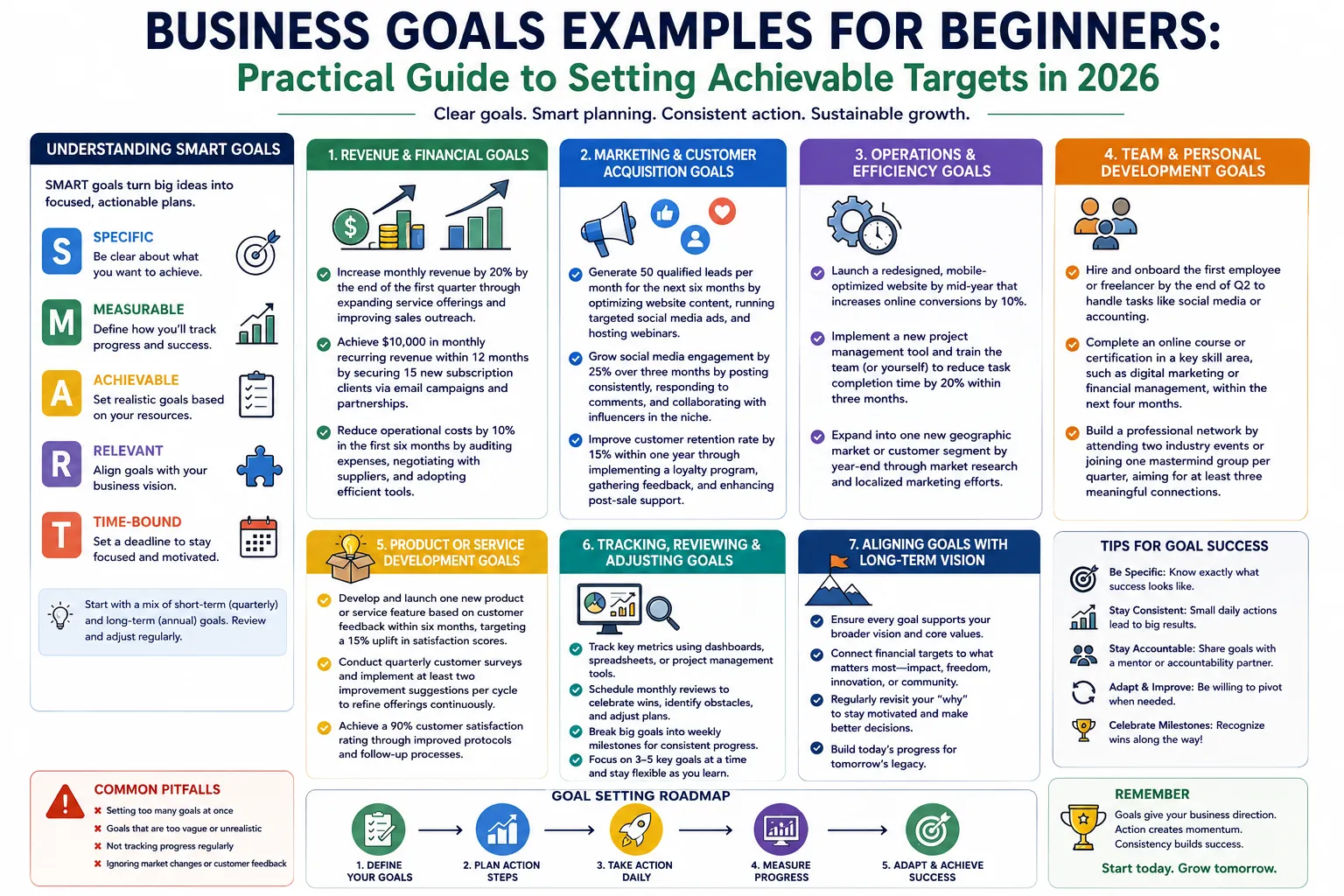
Starting a business requires clear direction to navigate challenges and measure progress. For beginners, well-defined goals provide focus, motivation, and a roadmap for growth. Effective goals follow the SMART framework—Specific, Measurable, Achievable, Relevant, and Time-bound—transforming vague aspirations into actionable plans.
This guide offers practical business goal examples tailored for new entrepreneurs and small business owners. Categories include revenue, marketing, operations, and personal development, with tips for implementation to build sustainable success.
Understanding SMART Goals for Business Success
SMART goals bring clarity and accountability. A vague aim like “grow my business” becomes specific and trackable, such as “increase monthly revenue by 15% through targeted online marketing within six months.” This approach helps beginners prioritize resources and track outcomes effectively.
Beginners should start with a mix of short-term (quarterly) and longer-term (annual) goals aligned with overall vision. Regularly review and adjust based on performance to maintain momentum.
Revenue and Financial Goals
Financial stability forms the foundation for any new venture. Beginners often focus on reaching consistent income while controlling costs.
- Increase monthly revenue by 20% by the end of the first quarter through expanding service offerings and improving sales outreach. This goal is specific, includes a percentage target, and ties to actionable steps like client acquisition.
- Achieve $10,000 in monthly recurring revenue within 12 months by securing 15 new subscription clients via email campaigns and partnerships. Track progress with monthly reports to ensure steady growth.
- Reduce operational costs by 10% in the first six months by auditing expenses, negotiating with suppliers, and adopting efficient tools. This supports profitability without sacrificing quality.
These examples emphasize realistic scaling for startups, allowing beginners to build cash flow while learning market dynamics.
Marketing and Customer Acquisition Goals
Attracting and retaining customers drives visibility and sales. Beginners benefit from measurable digital efforts.
- Generate 50 qualified leads per month for the next six months by optimizing website content, running targeted social media ads, and hosting webinars. Measure success through lead tracking software.
- Grow social media engagement by 25% over three months by posting consistently, responding to comments, and collaborating with influencers in the niche. This builds brand awareness organically.
- Improve customer retention rate by 15% within one year through implementing a loyalty program, gathering feedback via surveys, and enhancing post-sale support. Retention often proves more cost-effective than constant acquisition.
Focus on channels that match the target audience, starting small to test what resonates before scaling.
Operations and Efficiency Goals
Streamlining processes prevents overwhelm for solo founders or small teams.
- Launch a redesigned, mobile-optimized website by mid-year that increases online conversions by 10%. This involves user testing and integration of e-commerce features if applicable.
- Implement a new project management tool and train the team (or yourself) to reduce task completion time by 20% within three months. Efficiency gains free up time for strategic work.
- Expand into one new geographic market or customer segment by year-end through market research and localized marketing efforts. This supports sustainable scaling.
Beginners should document processes early to identify bottlenecks and create repeatable systems.
Team and Personal Development Goals
Even solo entrepreneurs need growth-focused goals. As the business expands, team-related targets become relevant.
- Hire and onboard the first employee or freelancer by the end of Q2 to handle specific tasks like social media or accounting, freeing founder time for high-level strategy.
- Complete an online course or certification in a key skill area, such as digital marketing or financial management, within the next four months to strengthen business capabilities.
- Build a professional network by attending two industry events or joining one mastermind group per quarter, aiming for at least three meaningful connections that lead to opportunities.
Personal development goals ensure the founder evolves alongside the business.
Product or Service Development Goals
Innovation keeps offerings competitive.
- Develop and launch one new product or service feature based on customer feedback within six months, targeting a 15% uplift in satisfaction scores.
- Conduct quarterly customer surveys and implement at least two improvement suggestions per cycle to refine offerings continuously.
- Achieve a specific quality metric, such as maintaining a 90% customer satisfaction rating through improved protocols and follow-up processes.
For beginners, validating ideas with real users before full investment minimizes risk.
Tracking, Reviewing, and Adjusting Goals
Success depends on consistent monitoring. Use simple tools like spreadsheets, dashboards, or free project apps to track key metrics. Schedule monthly reviews to celebrate wins, identify obstacles, and pivot as needed. Beginners should break large goals into weekly milestones for steady progress.
Common pitfalls include setting too many goals simultaneously or ignoring external factors like market changes. Prioritize 3-5 key objectives at a time and align them with available resources.
Aligning Goals with Long-Term Vision
Effective goals support broader aspirations, such as building a sustainable brand or achieving work-life balance. For example, revenue targets should connect to personal values like community impact or innovation. Regularly revisit the “why” behind each goal to sustain motivation during challenges.
Conclusion
Business goals provide beginners with structure amid uncertainty. By applying the SMART framework and drawing from examples in revenue, marketing, operations, team building, and product development, new entrepreneurs can set realistic targets that drive meaningful progress.
Start small, remain consistent, and view goals as flexible guides rather than rigid rules. With regular tracking and adaptation, these objectives lay the foundation for growth, resilience, and long-term success in 2026 and beyond. Taking the first step toward defined goals often marks the difference between aspiring and achieving in the entrepreneurial journey.