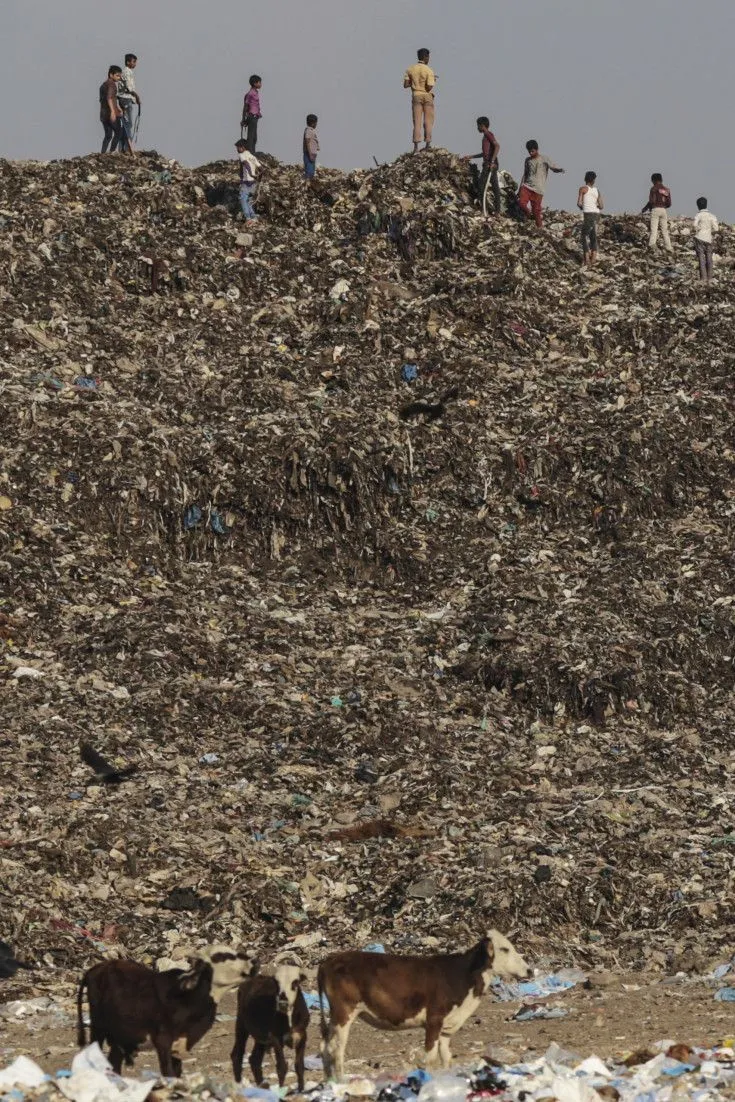
The smell announces the place long before the eye confirms it. Sharp, heavy and persistent, it drifts across neighbourhoods in north Delhi. Then the landscape itself comes into view: an uneven, unnatural rise against the skyline that for years resembled a mountain more than a municipal facility. This is the Bhalswa landfill, one of the capital’s most visible symbols of accumulated waste. Today that mountain is being taken apart, piece by piece, through one of the largest biomining operations in the city.
A Mountain Built Over Decades
Bhalswa grew the way many Indian urban landfills did—through years of unrestricted dumping. Household garbage, commercial waste and construction debris were layered on top of one another with little segregation or scientific management. Over time the site expanded across roughly 70 acres. By June 2022, when sustained remediation began in earnest, the landfill was estimated to hold about 73 lakh metric tonnes of legacy waste. The mound reached heights that dominated the surrounding low-rise housing and open land, creating persistent problems of odour, leachate, fire risk and air pollution for nearby communities.
The scale made simple removal impossible. Shifting the entire mass to another location would only relocate the problem. What was required was a method that could process the waste on site, recover usable material and gradually reclaim the land.
Biomining: Taking the Mountain Apart
The chosen approach is biomining. Excavators dig into the decades-old layers and feed the material into screening and separation systems. The waste is broken down into different streams. The largest fraction, typically 65 to 75 per cent of what is processed, is inert material—largely soil-like residue that remains after organic matter has degraded and recyclables have been removed. This inert portion is transported to low-lying areas in parts of the city, including zones in Narela and Rohini, where it is used as fill.
Recyclable materials are recovered wherever feasible. Other fractions are directed toward appropriate disposal or further processing. The operation does not simply move a garbage pile from one place to another; it dismantles and reclassifies it. On productive days the site has processed in the range of 12,000 to 15,000 tonnes, though rain and operational conditions regularly affect the rate.
Measurable Progress
By the end of July 2026, official figures indicated that more than 99 lakh metric tonnes of legacy waste had been remediated at Bhalswa. Significant portions of the original footprint have been cleared. Reviews in mid-2026 reported that around 43 acres of the roughly 70-acre site had been reclaimed, visibly lowering the profile of the once-dominant mound. The maximum height, which had stood at several dozen metres, has been substantially reduced.
The Municipal Corporation of Delhi and the city administration have set ambitious targets. Updates have pointed to clearance of the remaining concentrated mound by mid-October 2026, with the broader goal of completing remediation of waste accumulated up to earlier cut-off dates by the end of December 2026. Fresh waste that continues to arrive is being handled through separate arrangements so that it does not continually rebuild what is being removed.
Challenges on the Ground
The work is neither linear nor easy. Monsoon rains saturate the material, making excavation and screening difficult and sometimes forcing multi-day pauses. Machinery faces abrasive, heterogeneous waste that includes plastics, textiles, construction debris and fine particles. Leachate—the liquid that drains from decomposing waste—requires ongoing management to prevent contamination of soil and water. Fire prevention remains a constant concern at any large landfill under disturbance.
There is also the pressure of daily fresh waste. Even as old layers are removed, new garbage continues to reach the site. Authorities have emphasised the need to accelerate processing capacity for incoming waste and to develop longer-term infrastructure, including waste-to-energy and other treatment facilities, so that new mountains do not form once the legacy burden is reduced.
Part of a City-Wide Effort
Bhalswa does not stand alone. Delhi has been pursuing parallel biomining and remediation at the Okhla and Ghazipur landfills. Officials have targeted completion at Bhalswa and Okhla by the end of 2026, with Ghazipur, the largest of the three, scheduled for 2027. Across the sites, millions of tonnes of legacy waste have already been processed and more than a hundred acres of land reclaimed in total. The effort represents one of the most sustained attempts by an Indian megacity to confront the physical legacy of decades of inadequate waste management.
What Reclamation Makes Possible
Once the waste is cleared and the ground stabilised, the reclaimed land opens new possibilities. Officials have spoken of developing green cover and exploring public-utility uses in consultation with the city government. For residents who have lived for years with the smell, the smoke from occasional fires and the visual presence of the mound, even partial progress brings tangible relief. Improved air quality, reduced leachate risk and the psychological effect of watching the mountain shrink matter in daily life.
A Race Against Accumulation
The story of Bhalswa is ultimately a race between removal and accumulation. Biomining can dismantle the past, but only sustained improvement in daily waste processing, segregation at source and treatment capacity will prevent the future from repeating the same pattern. The current operation demonstrates that large legacy sites are not immovable. With consistent machinery, monitoring and political attention, even a mountain of garbage can be reduced to manageable fractions and usable land.
Delhi’s experience at Bhalswa will be watched by other cities facing similar monuments to untreated waste. The technical process is demanding and the timelines have shifted before. Yet the visible lowering of the mound and the steady tally of tonnes processed show that the work is advancing. The smell may linger for some time yet. The mountain, however, is no longer growing unchecked. It is being taken apart, one screened load at a time.
Read more – leventescortq.com