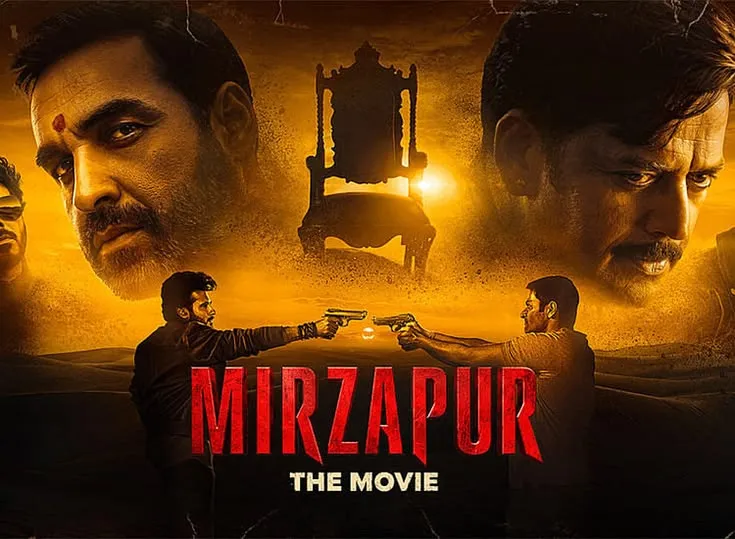
Mirzapur: The Movie has arrived in theatres as a commercial success, drawing strong openings and steady collections without relying on conventional superstar power. The film’s performance has revived a familiar debate that often accompanies screen-to-theatre transitions: is the audience responding to a genuinely compelling cinematic experience, or is the excitement largely fuelled by the chance to reunite with characters and a world they already love?
A Franchise Steps Onto the Big Screen
The original Mirzapur series built a dedicated following through its raw depiction of power, loyalty, ambition and violence in the badlands of Uttar Pradesh. Characters such as Kaleen Bhaiya, Munna, Guddu and others became pop-culture reference points, their dialogues and mannerisms circulating far beyond the screen. When the story moved to theatres, that existing emotional investment became an immediate advantage.
Early box-office figures reflected this ready-made audience. The film opened strongly, grew over the weekend, and crossed major collection milestones within days. Trade observers noted that the response was particularly robust in single-screen centres and regions where the series had deep cultural resonance. The absence of a traditional star vehicle made the numbers more striking and pointed to the strength of the franchise itself.
What Critics and Audiences Are Saying
Critical response has been largely positive to mixed. Many reviewers have praised the performances, especially the return of familiar faces who slip back into their roles with ease. The dialogues, confrontations and bursts of mass energy have been highlighted as crowd-pleasing strengths. The film’s ability to deliver the signature tone of the series—gritty, loud, darkly humorous and unapologetically pulpy—has been widely acknowledged.
At the same time, several critiques have focused on length, pacing and narrative familiarity. Some have described stretches of the film as indulgent or predictable, noting that the story sometimes prioritises giving every major character a moment over maintaining tight momentum. The runtime has been repeatedly flagged as a hurdle for viewers less invested in the universe.
Audience reactions, particularly from those already familiar with the series, have leaned more enthusiastic. Social media and theatre reports frequently mention the thrill of seeing the characters on a large screen, the satisfaction of familiar power dynamics, and the pleasure of hearing iconic lines land with a theatrical crowd. For many, the film functions as an extended, heightened visit to a world they already inhabit rather than an entirely new proposition.
The Weight of Nostalgia
Nostalgia is clearly a significant part of the film’s appeal. Returning to a well-established universe lowers the barrier to entry for existing fans and raises the emotional stakes of every confrontation and alliance. The pleasure of recognition—spotting character traits, anticipating certain dynamics, or simply hearing a signature line—can carry an audience through stretches that might feel slower to a newcomer.
This dynamic is common in franchise filmmaking. When characters have already earned affection and cultural currency, the bar for engagement shifts. Viewers arrive pre-invested. The film does not need to build attachment from zero; it only needs to reactivate it and then deliver enough spectacle, conflict and resolution to justify the theatrical outing.
In the case of Mirzapur: The Movie, that reactivation appears to have worked. The sense of “bhaukaal” returning to the big screen has been a recurring theme in audience conversations. For fans, the film offers the satisfaction of scale: larger set pieces, louder impact, and the communal experience of watching familiar chaos unfold in a darkened theatre.
Does It Stand on Its Own?
The more difficult question is whether the film succeeds as a self-contained piece of cinema. Reviews suggest a split. Those who know the series tend to find greater reward in the character interplay, the continuation of long-running tensions, and the specific flavour of the writing. Viewers approaching it without that background may appreciate the performances and the surface energy but can find the narrative less urgent or the emotional payoffs less resonant.
The film reportedly provides enough context for newcomers to follow the central power struggles. Yet the richest experience, according to many accounts, belongs to those who already understand the history, rivalries and personal costs that shape these characters. In that sense, the movie functions more as a companion piece or a theatrical expansion of the series than as a fully independent entry.
This does not diminish its entertainment value for its core audience. It does, however, place limits on how widely the film can be claimed as a universal cinematic achievement. Its strengths are closely tied to the pre-existing world and the performances that define it.
Box Office as a Measure of Connection
The commercial performance offers its own evidence. A film without major star names clearing significant collection thresholds in a competitive market indicates genuine demand. That demand appears rooted in affection for the franchise rather than in novelty alone. Word-of-mouth among fans, strong occupancy in key territories, and the willingness of audiences to turn up for a long runtime all point to a relationship that was built over multiple seasons of television and has now been successfully translated to theatres.
At the same time, box-office success and critical or artistic accomplishment are not identical. A film can satisfy its audience, generate strong numbers, and still rely heavily on the goodwill of what came before. Mirzapur: The Movie seems to occupy that space: effective at delivering what its fans want, competent in its craft, and elevated by the charisma of its central performers, yet not entirely free of the structural looseness that can accompany franchise expansions.
A Successful Reunion with Limits
The most accurate assessment may be that the film is both things at once. It is a successful reunion that capitalises on deep audience attachment to its characters and tone. It is also a functional big-screen entertainer that understands the grammar of mass appeal—sharp dialogues, heightened confrontations, and a climax designed to leave the crowd satisfied.
It is less clear that it transcends the franchise to become a standalone great film in a broader cinematic sense. Its pleasures are most potent for those already fluent in its language. For them, the return of Kaleen Bhaiya, Munna, Guddu and the rest feels like a genuine event. For others, it remains an accessible but secondary experience.
In the end, Mirzapur: The Movie demonstrates the commercial power of a well-loved universe and the enduring appeal of characters who have already earned their place in popular culture. Whether that makes it a great film or primarily a great reunion depends on what a viewer brings into the theatre. For the franchise’s dedicated audience, the distinction may not matter much. The bhaukaal has returned to the big screen, and for many that is more than enough.
Read more – tastymenuideas.com