Scientists have identified small, short-lived brightenings in the Sun’s atmosphere that appear hours before a major solar flare and gather around the precise location where the flare later erupts. The findings come from a collaborative study involving researchers from the Manipal Centre for Natural Sciences at the Manipal Academy of Higher Education, scientists from the Indian Space Research Organisation, the Department of Space, and other academic partners. The work relies on simultaneous ultraviolet and X-ray observations from India’s Aditya-L1 solar mission.
Observations from Aditya-L1
The study drew on data from three instruments carried by Aditya-L1. The Solar Ultraviolet Imaging Telescope, known as SUIT, observed the Sun through eleven near-ultraviolet filters. These filters reveal different layers of the solar atmosphere, ranging from the upper photosphere to the chromosphere. Near-ultraviolet wavelengths are largely blocked by Earth’s atmosphere, making space-based observations essential.
Two X-ray instruments complemented the ultraviolet data. The Solar Low Energy X-ray Spectrometer and the High Energy L1 Orbiting X-ray Spectrometer measured energetic processes occurring higher in the solar corona. By combining the datasets, the researchers examined how activity in the lower atmosphere connects to energy release in the corona during the build-up to a flare.
Pre-Flare Transient Events
Analysis focused on several solar flare events observed in the magnesium II h filter of SUIT. In the hours preceding major flares, the team detected numerous small, short-lived brightenings described as transient events. These brightenings appeared within active regions—areas of intense magnetic activity on the Sun.
Importantly, the transient events clustered around the specific site where the larger flare later occurred. Some of the brightenings also produced corresponding X-ray signatures. The presence of X-ray emission indicates that the small events involved the release of stored magnetic energy rather than simple thermal fluctuations.
Progressive Destabilisation of the Magnetic Field
According to ISRO, the results point to a cumulative process. Repeated small-scale energy releases appear to progressively weaken or destabilise the magnetic field within an active region. Over time, this accumulation of minor disruptions can push the region past a critical threshold, triggering a large solar flare.
This interpretation offers a physical link between the modest brightenings observed in the lower atmosphere and the eventual explosive release of energy higher up. It suggests that major flares do not arise suddenly in isolation but develop through a sequence of smaller precursor events that prepare the magnetic configuration for a larger eruption.
Why These Findings Matter
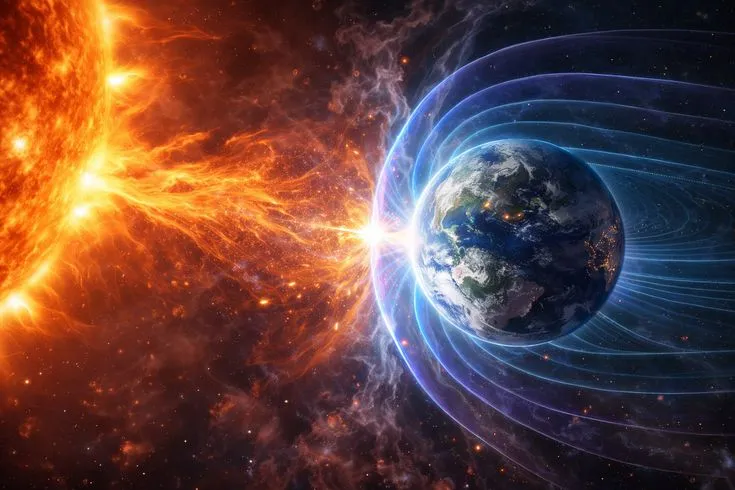
Solar flares release enormous amounts of energy across the electromagnetic spectrum and can accelerate particles into interplanetary space. When directed toward Earth, they contribute to space weather disturbances that affect satellite operations, high-frequency radio communications, power grids, and navigation systems. Improving the ability to recognise early signs of an impending flare is therefore of practical importance for space weather forecasting.
Previous research has explored various potential precursors, including changes in magnetic complexity, flickering of coronal loops, and variations in non-thermal emission. The new study adds a distinct observational signature: localised, repeated brightenings in the near-ultraviolet that are spatially concentrated at the future flare site and sometimes accompanied by X-ray signatures.
Because Aditya-L1 continuously monitors the Sun from the first Lagrangian point, it provides a steady stream of simultaneous multi-wavelength data. This capability allows researchers to examine the temporal and spatial relationship between lower-atmosphere activity and coronal energy release with greater clarity than was previously possible from ground-based or single-instrument observations.
Broader Context of Solar Research
Understanding the sequence of events that lead to a flare remains one of the central challenges in solar physics. Magnetic reconnection—the breaking and rejoining of magnetic field lines—is widely accepted as the mechanism that converts stored magnetic energy into heat, radiation and particle acceleration. How a region reaches the point of large-scale reconnection is less fully understood.
The observation of repeated small-scale energy releases provides evidence that the build-up phase involves a series of minor reconnection events or instabilities. Each event may slightly alter the magnetic topology, reducing overall stability until a major release becomes inevitable. Mapping these precursors more systematically could eventually support improved short-term forecasting of flare occurrence and location.
Next Steps and Limitations
The current analysis examined several flare events. Expanding the sample size across different flare magnitudes and active-region types will help determine how consistent the precursor pattern is. Researchers will also need to establish whether the frequency, intensity or spatial distribution of the transient events correlates with the eventual size of the flare.
Further work may explore whether similar signatures appear in other wavelength bands or whether the X-ray counterparts can be used as an independent confirmation of energy release. Continuous monitoring by Aditya-L1 and complementary observations from other solar missions will supply the additional data required for these investigations.
Contribution of India’s Solar Mission
Aditya-L1, India’s first dedicated solar observatory, was designed to study the Sun’s photosphere, chromosphere and corona across multiple wavelengths. The successful detection of pre-flare transient events demonstrates the scientific value of its instrument suite, particularly the unique near-ultraviolet imaging capability of SUIT combined with simultaneous X-ray spectroscopy.
The collaboration between university researchers and ISRO scientists illustrates how data from the mission is being used to address fundamental questions in solar physics while also contributing to the practical goal of better space weather awareness.
The identification of small-scale brightenings that cluster at the future site of a major flare represents a concrete observational advance. By linking these repeated energy releases to the progressive destabilisation of the magnetic field, the study offers a clearer picture of the processes that precede solar flares and opens a promising avenue for further research into early warning indicators.
Read more – Instantdua.com