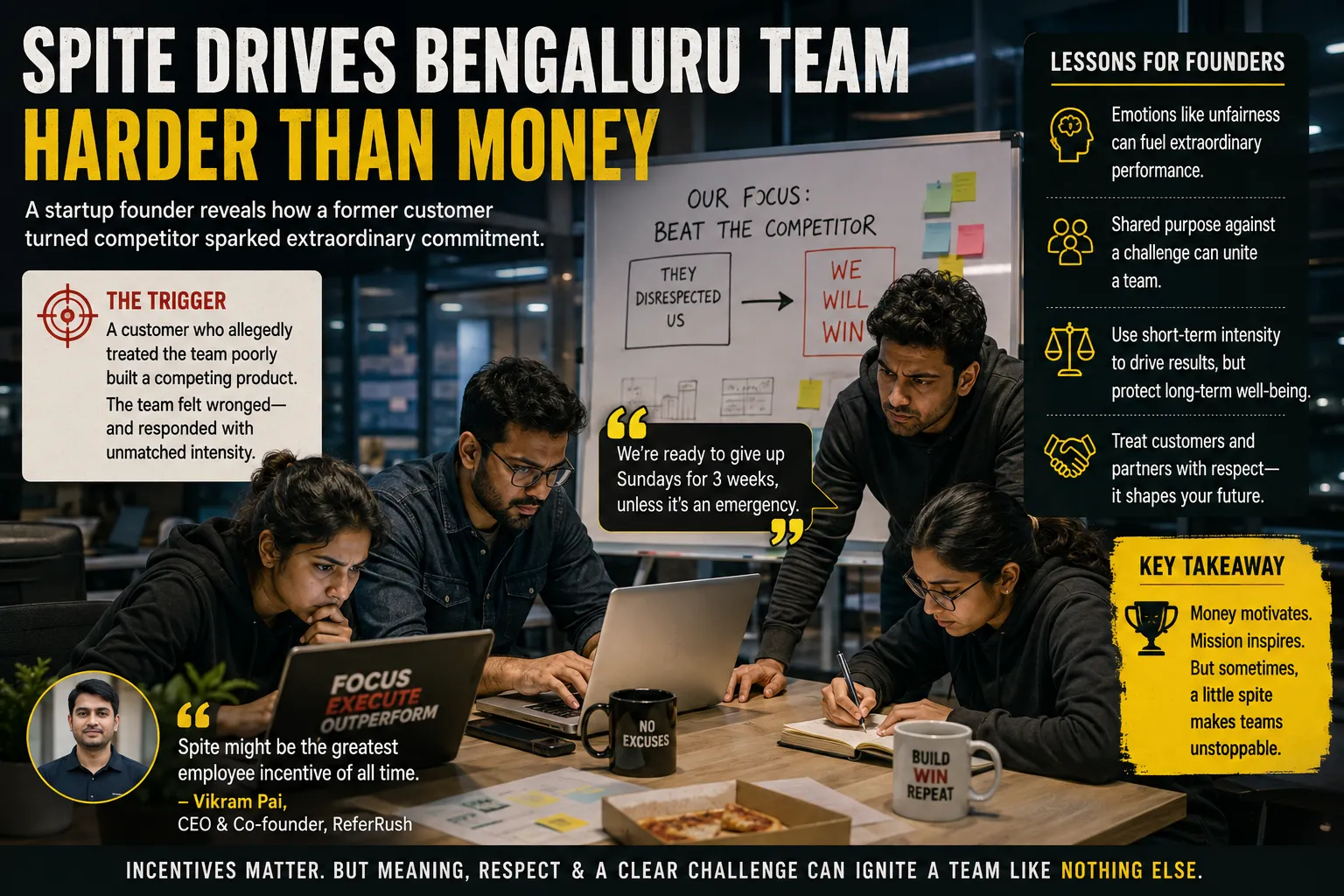
In Bengaluru’s competitive startup ecosystem, employee motivation is usually discussed in terms of salaries, bonuses, stock options and work-life balance. A recent account from ReferRush CEO and co-founder Vikram Pai has added an unexpected element to that conversation. Pai shared that his team began voluntarily working late nights and Sundays not because of financial incentives, but in response to a former customer who allegedly treated them poorly and later launched a competing product.
The Trigger: From Customer to Competitor
According to Pai, a customer who had interacted poorly with his team decided to build a rival offering. The shift from client to competitor created a strong emotional reaction inside the company. Employees who had previously been difficult to accelerate through conventional means suddenly displayed heightened urgency and commitment.
Pai stated that he had already experimented with the standard toolkit available to founders. Bonuses, performance incentives, tight deadlines and equity grants had all been tried in an effort to increase speed and output. None of these, he said, produced results comparable to the response triggered by the emergence of the competing product. Team members began putting in extra hours of their own accord, including nights and weekends.
One employee message shared by Pai indicated a willingness to forgo Sundays for three weeks except in the case of an emergency. The founder described the collective mood as one of anger directed at the former customer’s decision, and noted that this sentiment translated into voluntary extra effort.
Spite as an Unconventional Motivator
Pai summarised the episode with a candid observation: spite might be the greatest employee incentive of all time. He acknowledged that, as a founder, he felt pleased by the surge in voluntary commitment even while recognising the unusual nature of its source. The comment was framed with a mix of humour and pragmatism rather than as a formal management philosophy.
The story quickly circulated on professional and social platforms, prompting discussion about what truly drives knowledge workers. In an industry where burnout, quiet quitting and demands for better boundaries are frequent topics, the idea that competitive resentment could outperform structured rewards struck many as both revealing and uncomfortable.
Broader Context of Startup Motivation
Startups commonly rely on a combination of intrinsic and extrinsic motivators. Equity is intended to create long-term ownership. Bonuses and incentives aim to align short-term effort with business goals. Deadlines impose external structure. Mission-driven narratives try to connect daily tasks to a larger purpose. Pai’s experience suggests that, at least in one instance, an external adversarial stimulus proved more effective than these internal levers.
Psychologically, the reaction is not entirely surprising. Perceived unfairness or disrespect can generate strong emotional energy. When that energy is directed toward a clear competitive target, it can temporarily override fatigue and the desire for personal time. In a small or mid-sized team, shared indignation can also reinforce group identity and create a sense of collective purpose against an outside party.
At the same time, reliance on negative emotion carries obvious risks. Anger is difficult to sustain productively over long periods. It can distort decision-making, increase stress, and eventually lead to exhaustion or interpersonal friction. What begins as energising rivalry may later require careful management if it becomes the primary cultural fuel.
Lessons for Founders and Managers
Pai’s account does not claim that financial incentives are irrelevant. Rather, it highlights their limitations when other psychological factors are at play. Teams that feel personally slighted or professionally challenged by a specific rival may display intensity that money alone cannot buy. Founders observing similar dynamics might note the power of narrative and shared stakes.
The episode also underscores the importance of how customers and partners are treated. A difficult relationship that ends in competitive entry can leave residual feelings that influence internal culture. While companies cannot control every former client’s subsequent choices, the quality of interactions during the commercial relationship can shape later perceptions.
For employees, the story raises questions about sustainable motivation. Working nights and Sundays out of determination can feel empowering in the short term, especially when the goal is to outperform a specific competitor. Over time, however, organisations still need systems that reward contribution fairly, protect rest, and prevent resentment from becoming the default operating mode.
A Mirror to Bengaluru’s Startup Culture
Bengaluru’s technology and startup scene is known for long hours, high ambition and intense competition. Stories of teams pushing hard to ship products or respond to market threats are common. Pai’s public reflection simply made explicit a less-discussed driver: the motivational force of personal and professional grievance.
Whether spite remains a lasting engine or proves to be a temporary spike will depend on how the company channels the energy. If the extra effort produces tangible progress and is later balanced with recognition and recovery, it may be remembered as a productive chapter. If it becomes an expectation without corresponding support, the costs could surface later.
For now, the account has served as a reminder that human motivation is rarely one-dimensional. Bonuses, equity and deadlines matter. So do fairness, respect and the presence of a clear external challenge. In this particular Bengaluru startup, the combination of a former customer’s alleged mistreatment and subsequent competitive move generated a level of voluntary commitment that more conventional tools had not achieved. The founder’s candid sharing of that reality has added a provocative data point to the ongoing discussion about what makes people work harder than required.
Read more – therecipetaste.com , uuploadarticle.com